
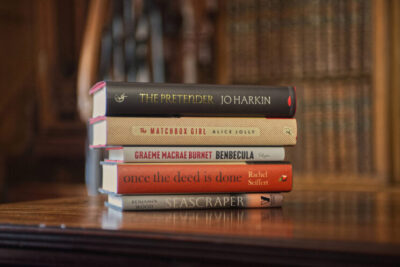
The 2026 Shortlist
The 2026 Shortlist comprised:
THE PRETENDER by Jo Harkin (Bloomsbury)
THE MATCHBOX GIRL by Alice Jolly (Bloomsbury)
BENBECULA by Graeme Macrae Burnet (Polygon)
ONCE THE DEED IS DONE by Rachel Seiffert (Virago)
SEASCRAPER by Benjamin Wood (Viking)
Spanning the centuries from the 1480s to the 1950s, the novels cover events and locations from the English Wars of the Roses to Austria and Germany during the Second World War, and a shocking true crime committed on a Hebridean island to an imagined encounter in a small community on the northwest coast.
The judges said:
“The five shortlisted novels for the 2026 Walter Scott Prize probe intimate lives lived in both small and big settings. Readers will hear voices usually unheard but which, once heard, won’t be forgotten. The shortlist choice is always difficult, but our authors each reveal the hidden, and in doing so offer new insights into our own times as well as the times in which their novels are set. Above all, our five authors are storytellers, so if you like a good story, the 2026 Walter Scott Prize shortlist is one you won’t want to miss.”
The shortlist announcement was accompanied by a video shot at Abbotsford and narrated by James Naughtie, which you can see here.
Here is what our judges said about each book:
THE PRETENDER by Jo Harkin
10 year old John Collan’s biggest challenge on the farm is a daily battle with Gaspard the malevolent goat. It’s a fight he rarely wins, but one that serves as a kind of preparation for the ‘history in real time’ that’s about to upend his world with the arrival at the farm of two mysterious well-dressed strangers. Jo Harkin has taken the idea of Lambert Simnel; Edward Plantagenet; pretender to the throne; and lost son of the Duke of Clarence, and run riot with it. Through multiple name changes (John/Simnel/Edward) we follow his coming-of-age like no other, from farm boy to usurper king, kitchen boy, to vengeful lothario. The Pretender takes a well-trodden era of history and gives the reader a rich, brilliant, fresh, bawdy novel, that is both convincing and very very funny.
THE MATCHBOX GIRL by Alice Jolly
‘In 1930s Vienna, young Adelheid Brunner quietly dreams of collecting 1,000 matchboxes, all while cataloguing meticulous observations about her surroundings in copious notebooks. Unsure of what to do with this strange child who does not speak, Adelheid’s grandmother takes her to a children’s hospital, where she encounters the inscrutable Dr A. As society becomes increasingly governed by suspicion and fear, what role can the hospital’s research – and its ‘treatment’ of the children in its care – play within an authoritative regime? Alice Jolly’s remarkably nuanced novel is as much a sharp examination of Dr Hans Asperger’s legacy as it is a moving tribute to a lost generation of children under Nazi rule. Balancing unflinching historical realism with a vivid imagining of the beginnings of autism diagnosis, The Matchbox Girl and its narrator are impossible to forget.
BENBECULA by Graeme Macrae Burnet
On the remote Outer Hebridean island of Benbecula in the mid-nineteenth century, labourer Angus MacPhee bludgeons to death his mother, father and aunt with a rock. As the savagery of the murders seeps into the peat and machair of the Scottish island, the small community, too, absorbs the horror of the crimes committed in its midst, the perpetrator’s brother-turned-narrator, Malcolm, even more than most. And thus the stage is set for Macrae Burnet’s powerful, innovative psychological novella, all the more haunting in its brevity. It takes its literary lead from the early innovators of the modern novel, James Hogg and Robert Louis Stevenson, with a neat and clever tale that beds its roots firmly in the gothic, with themes of madness, isolation and morality at its dark heart. What happens when communities are tarred by association, and is it possible to keep the right side of madness when all around you madness abounds? Benbecula is as far removed from the recent cosy-crime tradition as it is possible to be: this is claustrophobic crime at its very best, and with so very much to admire.
ONCE THE DEED IS DONE by Rachel Seiffert
‘A story not often explored in fiction is the fate of millions of slave workers imported into Germany by the Nazis from Ukraine, Russia and Poland, to be worked, often to death, in German factories. Once The Deed Is Done, Rachel Seiffert’s outstanding novel, is set in a workers’ camp which has recently been liberated by the British and become a camp for displaced persons. The men, women, and even children, have suffered appalling deprivation. Now, helped by Ruth, a British Red Cross officer, they must come to terms with what has happened to them as they face an uncertain future. But the camp is just outside a small German town, and the townspeople too are rapidly adjusting to the reality of their defeat. In different ways, they must detach themselves from the Nazi state of mind and begin to take in the horror of what their country has done. Full of feeling but without sentimentality, Once The Deed Is Done is a complex and ambitious novel.’
SEASCRAPER by Benjamin Wood
‘In the hands of skilled and confident novelists, small lives make big stories. Benjamin Wood is such a novelist, and in Seascraper his gift to us is Thomas Flett, a shanker, scraping for shrimp in Longferry, a holiday town on England’s northwest coast. The town has a promenade but in March Longferry is ‘just another dismal place’ to pass through. Thomas dreams of music; he has traded his grandfather’s pocket-watch for a guitar. A visitor arrives. A song is written. But the marvel of the story, and the tension, lie in the measured way Wood draws us into the life of a boy thirled to a habit, and even though Thomas eschews a motor rig in favour of the old horse and cart, this is no sentimental journey. The horse is nameless; the work ‘drudging’; the sinkpits waiting to swallow you up. Seascraper is a rich read, one to be savoured. When you come to the end you’ll want to start again.’