
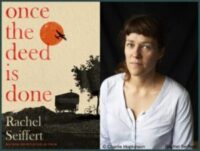
Shortlist Spotlight: Rachel Seiffert
2nd June, 2026
Read shortlisted author Rachel Seiffert’s fascinating account of how she researched Once The Deed Is Done and how it was inspired by real people and accounts.
Q: How do you feel about being shortlisted for the Walter Scott Prize for Historical Fiction? Do you consider yourself an historical novelist?
Thrilled! It’s a special award, run by enthusiasts. I also have strong Scottish connections: I lived in Glasgow for eight years, did my masters and PhD there, married a Scot, gave birth to my son in Yorkhill Hospital. I’ll be bringing my daughter to Abbotsford and we’ll be using the trip as a lovely starting point to visit family in Dundee and Carnoustie.
The Walter Scott criteria is that nominated books must be set largely 60 years or more in the past; strictly speaking, not all of my books meet this, however, all of them are about how past events shape lives. Characters drive my writing. I am interested in the individual in history, people at the sharp end of forces beyond them. My characters have included the 12 year old daughter of an SS officer in the weeks after the German defeat; a Polish seasonal farm-worker in Germany after the fall of the Iron Curtain; a British squaddie in early 1990s Northern Ireland, not so long before the Good Friday Agreement, but still a world away from it.
Q: How did the people and times you write about in this novel first lodge in your imagination?
This novel was a long time in the making. It was five years in the writing, but there are characters in here I have wanted to write about for far longer. The two old Berger sisters who live in the villa by the town woods are a double version of my Tante Lily, for example, my great aunt, who I knew in childhood. Frail but fierce at the same time, she lived in Hamburg and was a blunt spoken anti-Nazi in a family who voted for Hitler, but claimed never to have liked the man. I loved how uncomfortable she made people by pointing out they always raised their arms, even if it was only halfway. She made it difficult for others in my family to lie to themselves, to spin stories that made living with their Third Reich choices easier.
The townsfolk who come calling at the schoolhouse after Arno’s return were inspired by reading Victor Klemperer’s diaries over a decade ago. I was amazed at how forgiving he was. A Dresden professor, he considered himself Christian having converted out of conviction in early adulthood, but was classed as Jewish under the Nazi race laws, and kept a diary of his Third Reich experiences and the years of their aftermath. He came so close to deportation, and so few of his neighbours, friends and former colleagues helped him, yet they came calling after the Nazi defeat, once they found out they required references of good character to obtain work under the Allies. These visits exhausted Klemperer, but he received them. What interested me was the mixture of embarrassment and entitlement in his visitors. Again: what stories had they told themselves to get themselves to his front door? What version of their Third Reich conduct did they think Klemperer might put his name to?
My family are from Hamburg; I have spent years looking into their Third Reich conduct and also what life was like under the Nazis there. Like many other German cities, Hamburg had a concentration camp on its outskirts. Neuengamme was a brickworks which became a prison works under the Nazis. Over the years, it housed socialists and communists, Jewish Germans and Ukrainian and Polish forced labourers. These prisoners weren’t always kept on the city outskirts, out of sight and out of mind. After the regular Allied bombing raids on Hamburg, Neuengamme inmates would be brought in to do the grim work of retrieving the bodies and clearing the rubble. A photograph from the time stood out for me. Two prison labourers, clearly in prison uniform, on a rubble-strewn Hamburg street. One is footing a ladder, the other is knocking the broken glass out of a window. Meanwhile two women are walking past them with shopping baskets, deep in conversation. An everyday scene of Third Reich life. I wanted to explore this knowing unknowing, how the awful could be so ordinary.
The spark for the novel which brought these characters & ideas together with so many others was a chance conversation with a historian. I was invited to give a talk at Royal Holloway, and got talking to Dan Stone afterwards, He’s head of Holocaust Studies there and had just completed a three year research project into the International Tracing Service. The ITS archive holds millions of documents about victims of the Nazis, hundreds of thousands of whom remained missing after the end of hostilities, despite decades of tracing efforts. Dan had been looking into the fate of missing children, in particular the children of forced labourers – and I hadn’t realised until then that children were brought to Germany to use as forced labour. Not only that, hundreds of thousands of these children were separated from their parents. The need to write about this felt urgent.
Q: What place does research have in your writing? When does the fiction take over from the facts?
You can see from my above answer that research plays a large part in my writing and thinking life! Research also takes many forms. Reading, conversations, finding images. Often it’s deliberate, sometimes its serendipitous.
Where does fiction take over?
Fiction condenses, so events often need to be compressed, or (better) viewed through a particular window in time.
Of course fiction sometimes takes liberties, but if you strain too much, forcing events or people together, then the story loses credibility, and (crucially) loses its chance to do its work on the reader.
I think I do most work on my characters. They will represent different historical drivers or ways of thinking (in the camp in my book, for example, there are forced labourers who want to return home, and those who want to strike out to the New World, put the horrors of the past behind them, because I found plenty of examples of these two wishes in the archives). However, characters also have to feel like people to the reader, real and tangible. Sometimes this takes a great deal of work. I had to sit for a long time with Stanislaw, for example, finding the details that would add up to a person rather than a symbol or a cypher. He’s an engineer because he could then work on the radios, bringing news to the camp, word from beyond it; he’s a teacher because he could then teach Mirko, teach Ruth too, and with patience; he’s a survivor, so he understands the compromises it takes to survive; but he’s been betrayed too, by someone close, so he knows the terrible cost to others that come with such compromises; finally, he is old and he is tired, so the New World feels too far for him to go – that’s for the young. It wasn’t until the last draft that this all came together.
Q: Can writing about the past help us to deal with the present and think about the future?
If all the issues which led to the horrors of the Third Reich had been dealt with, there would be little need to write about them. I go back to those times in my research and writing because they say something to me about my family, about humans more widely, and also about now. Defeating the Third Reich took an international effort, and led afterwards to international recognition of important principles. We recognised there is a crime called genocide, for example, that there are Human Rights, and we have extended our ideas about what constitutes a war crime or a crime against humanity. Now, this consensus is under immense strain. Old allegiances are fraying, principles which seemed foundational are foundering. For me, this was a key driver over the five years of writing Once The Deed is Done. Russia’s invasion of Ukraine, the October 7th attacks and Israel’s bombing of Gaza all occurred while I was writing; the political fracturing in Britain and Germany has opened deep divisions within both my home countries. I chose to write about war’s aftermath because I wanted to look at the accommodations people have to make with their consciences, but I also wanted to look at how people survive. If your subject is people at the sharp end of history, you find people in extremis. So you find horror, of course, but you also see human strength and capacity to endure. I found hope in the archives; I wanted to put hope in my novel too. We need it to carry us forward.