
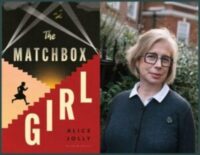
Shortlist Spotlight: Alice Jolly
19th May, 2026
Alice Jolly, author of The Matchbox Girl, talks to us about her research and inspirations for her novel.
Q: How do you feel about being shortlisted for the Walter Scott Prize for Historical Fiction? Do you consider yourself an historical novelist?
Thank you so much! I am absolutely thrilled to be shortlisted for the prize. This gives my book a chance to reach a much wider audience. For me, the prize seems to do really important work in advocating for historical novels as a serious and important subset within the mainstream of the writing and studying of history. On a less serious note, I tend to get my best reading recommendations from the longlists and shortlists for the prize.
I have written both historical and contemporary novels. On the level of the line, there is less difference than you might expect. You need to make the reader believe in the world you are creating. It is difficult to represent the 1400s but it can be equally difficult to portray events in the 1990s – the challenge is different but also essentially the same.
Q: How did the people and times you write about in this novel first lodge in your imagination?
I have been fascinated by the Second WW since my teens. I remain constantly troubled by that age of old question as to how people who were certainly not wholly ‘evil’ nevertheless found themselves drawn into appalling crimes. In 2018, two non-fiction books about the history of autism were published which told wildly differing stories about Dr Asperger. My book started with the simple question – who was Dr Asperger? However, as I worked, I began to realise that Asperger’s forgotten colleagues were perhaps more interesting than he was. I became obsessed with bringing them into the light and celebrating the ways in which the staff of the Curative Education Ward in Vienna struggled to hold onto their research, and their principles, despite finding themselves in the eye of the most evil storm of the twentieth century.
Q: What place does research have in your writing? When does the fiction take over from the facts?
Research is everything. In writing this book I felt that I was peeling back the layers of the past. I kept thinking, ‘Now I understand this.’ Then another layer would lift away and the story would change again. I am interested in the instability of the past and the stories we tell about it.
I am highly suspicious of a binary which says that ‘facts’ are boring and ‘fiction’ is exciting. I equally reject the idea that, ‘You can’t let facts get in the way of a good story.’ In reality, the story you find within the facts will be better than anything you can invent. Also, there is a moral responsibility to try to present the past as accurately as you can. The word ‘plausible’ is important in the writing of historical fiction. Sometimes no matter how much research you do, you just can’t know, so you need to make an educated guess about what might plausibly have happened using the factual framework you have.
Q: Can writing about the past help us to deal with the present and think about the future?
I think that it most certainly can, but this does not happen in the obvious way. Fiction isn’t about learning lessons, it is about building understanding and empathy. Books do change us, but they do their work in ways which are nuanced and unpredictable. The effect will be different for each individual reader. The writer lays out certain scenes. The writer does the rest of the work. Personally, I am really interested in moral ambiguity because I want to push readers to ask – what would I have done? I think historical fiction builds humility and hope. Humility because it stops us feeling smug about our own times and mitigates against the making of snap judgements about the people of the past. Hope because whatever we are facing in our current moment we can see that the people of the past faced worst – and that the human race keeps coming through in one way or another.