
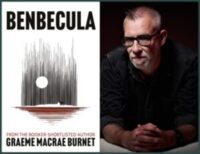
Shortlist Spotlight: Graeme Macrae Burnet
26th May, 2026
In our third Shortlist Spotlight interview, Graeme Macrae Burnet talks about his novel Benbecula.
Q: How do you feel about being shortlisted for the Walter Scott Prize for Historical Fiction? Do you consider yourself an historical novelist?
I couldn’t be more thrilled to be on the shortlist for the Walter Scott Prize. It’s tremendously gratifying to have one’s work considered worthy of a prize of this stature.
I don’t particularly think of myself as a historical novelist, but given that all my books are set in the past, maybe I am one! I suppose I just think of myself as a novelist, and as such I try to inhabit the lives of my characters whether they exist in Scottish Highlands of 1857 or a small French town in 1979.
Q: How did the people and times you write about in this novel first lodge in your imagination?
I first came across the case of Angus MacPhee over a decade ago when I was writing and researching my earlier book His Bloody Project. The parallels between the fictional case I was writing about and a real-life triple murder in Normandy in 1835 which had inspired it were really striking. So when I was invited to contribute to Birlinn’s Darklands series it was a story I was very keen to explore it in greater detail.
Q: What place does research have in your writing? When does the fiction take over from the facts?
I love research, particularly of the archival nature that I carried out for Benbecula. The witness statements, legal documents and maps held in the National Records Office in Edinburgh absolutely formed the narrative spine of the book. But while I felt an obligation to the facts of the case insofar as they can be known, I was also conscious that I had to try to bring the setting and the characters to life novelistically. I’m not sure I would say that fiction ‘takes over’ from the facts, more that the facts are a kind of spring board for the fiction to leap off. Certainly there are always moments in the writing of a book, when I’ve felt that it’s taking off – usually when something happens that I didn’t myself see coming.
Q: Can writing about the past help us to deal with the present and think about the future?
Absolutely, but as I novelist I would never try make this sort of thing explicit. I think it’s for individual readers to draw parallels if they so wish. But even in an extreme case like the triple murder dealt with in Benbecula there are very clear resonances with contemporary questions about criminal responsibility and how people experiencing psychological difficulties are cared for in the community.