
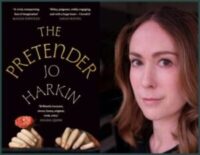
Shortlist Spotlight: Jo Harkin
12th May, 2026
The first of our Shortlist Spotlights is on Jo Harkin, who talks to the WSP about her first historical novel The Pretender.
Q: How do you feel about being shortlisted for the Walter Scott Prize for Historical Fiction? Do you consider yourself an historical novelist?
I’m incredibly thrilled to have been shortlisted for such a prestigious award, in such distinguished company. At the same time there’s a sense of unreality – even disbelief – because I’ve never considered myself to be a historical novelist and certainly wouldn’t have expected to be thought of as a good one. I’ve always loved history but have no academic background, and this is my first historical novel. This shortlisting has helped me to trust that it won’t be my last.
Q: How did the people and times you write about in this novel first lodge in your imagination?
Against my will. I’d written a sci-fi debut and was supposed to be writing another. But, as a pro-level procrastinator, I had abandoned the neurology paper I’d been reading as research and picked up a book about the kings and queens of England. It wasn’t an academic book. It might even have been a children’s book. There were a lot of pictures. Lambert Simnel was mentioned in a footnote. His strange story – a child put forward to dethrone a king – made me curious, and googling didn’t resolve my curiosity. I kept thinking about Simnel when I was meant to be thinking about my high concept sci-fi. In the end I gave in and abandoned the near future for the distant past.
Q: What place does research have in your writing? When does the fiction take over from the facts?
I’m not interested in writing alternate history, so I wanted to do a thorough job of research to make sure the setting, culture and daily life of my characters was accurate to the period. I spent around four years on that, and I still found myself having to go and look something up every page or so. For example, I’d have a character mopping the floor and then I’d have to check – did they have mops? What was the flooring?
When it comes to fact vs fiction I’ve adopted the approach of the great Hilary Mantel in that when a (reliable) historical record exists I stick to it, even if it’s inconvenient to my plot. Only where the historical record is blank have I felt free to invent. I did game the system in that respect though – in that Simnel’s story has so many huge expanses of uncharted territory. His origins are a mystery; his inner life is something we can never know. And after his Yorkist invasion failed and he was pardoned by Henry VII, his entire adulthood was narratively up for grabs.
Q: Can writing about the past help us to deal with the present and think about the future?
The more I look at history, the more its cycles are apparent. I used to think that human civilisation was evolving in a linear way in terms of democracy, tolerance and education, but now I wonder if our present progressiveness is just another phase, before inequality and pressure on resources prompts a swing back to authoritarianism. And I’m not sure that committing our history to print can prevent it recurring. Many, many works have expanded our understanding of the Holocaust and World War II for example, but we don’t yet live in a world free of genocide and war. Perhaps the best thing our historical literature can do is give a sense of perspective: that even if the wheel turns and we plunge into darkness, another turn could bring us into the light again.
You can meet Jo and the other authors on the 2026 Shortlist at the Walter Scott Prize event at the Borders Book Festival on 11th June – tickets available here!